Showing posts with label dkos diary. Show all posts

Tuesday, September 26, 2006

Anti-contraception Movement... the Groundwork

On Monday I posted about the Christian Right’s coming battle against contraception (shorter version: none for anyone ever) and mentioned my grudging admiration for the morality brigades’ perseverance and dedication to to their mission, abhorrent as I personally find it. Part of the strategy has been to crank out the kids like bunnies, homeschool them, send them to evangelical colleges, and groom them to enter public life so as to influence legislation at every level, toward the ultimate goal of crafting laws reflecting conservative Christian values (or Biblical literalism, depending on how pessimistic you’re feeling at any given moment).

The articles in the Chicago Tribune and LA Times mentioned the intent to chip away at the availability of contraceptives, following the manner in which abortion access has been steadily constricted, in large part by enacting state laws giving pharmacists the right to refuse to dispense medications that violate their own personal consciences.

Four States (Arkansas, Georgia, Mississippi, and South Dakota) have passed laws allowing a pharmacist to refuse to dispense emergency contraception drugs. Illinois passed an emergency rule that requires a pharmacist to dispense FDA approved contraception. Colorado, Florida, Maine and Tennesee have broad refusal clauses that do not specifically mention pharmacists.

California pharmacists have a duty to dispense prescriptions and can only refuse to dispense a prescription, including contraceptives, when their employer approves the refusal and the woman can still access her prescription in a timely manner.

Given the increasing presence of evangelicals in legislatures of all levels over the past decade or so, I wondered if they might be stacking the pharmaceutical deck as well. So it came as little surprise that the Christian Pharmacists Fellowship International has established student chapters in 30 pharmacy schools out of the 89 or so institutions granting at least a B.S. in pharmacy across the country, including at major players such as Purdue, North Carolina, and Florida.

The CPFI position on the “conscience clause” is as follows (emphases mine):

Pharmacists have the moral and legal responsibility to refuse to dispense a prescription that, in the pharmacist's judgment might be harmful to the patient, either directly or indirectly. Therefore, the Board of Directors of CPFI supports the right of all pharmacists to refuse to dispense a prescription that goes against their moral conscience.

No regulatory authority should be allowed to force a pharmacist to dispense a prescription against his/her best judgment or refer a patient to another healthcare provider. Likewise, a pharmacist should not engage in any activity that impairs a patient from seeking care from another provider.

Furthermore, the Board acknowledges the responsibility of Christian pharmacists to follow Biblical principles including the sanctity of life and life begins at the time of conception. Therefore, CPFI supports the right of Christian pharmacists, based upon Biblical principles and their moral convictions, to exercise their conscience within the realm of professional practice.

The “either directly or indirectly” phrase is quite vague, and it’s difficult to think that was unintentional. Indirect harm to a patient covers a troublingly wide expanse of territory, including that nebulous realm of the patient’s eternal soul—presumably the target of the conscience clause refusals. The insistence that pharmacists shall not be compelled to refer the patient to the other, non-evangelical pharmacist at Walgreen’s or to the CVS down the street is troubling. And the “responsibility” of Christian pharmacists to insist that life begins at conception is the grand finale, the big cake topper.

To be fair, CPFI maintains chapters at only slightly more than a third of the major pharmacy schools in the US (I did not consider associate-degree-only colleges and technical schools in this compilation), and most of these schools support a variety of student organizations. The faculty advisors don’t mention CPFI prominently in their online profiles, if at all, and there is no evidence that the organization is exerting undue influence within the respective colleges of pharmacy. Nor are hard membership numbers readily available.

In that sense, this posting may reflect more paranoia than imminent threat to freely accessible contraception in the US. However, given the numbers of students in the programs where CPFI is present*, it is an unavoidable fact that pharmacists who are very likely to invoke a conscience clause (or push for such legislation in states where it has not yet been enacted) are being churned out at a steady rate. Additionally, ample anedotal evidence exists documenting instances in which individuals have encountered absurd, near-Atwoodian barriers to acquiring emergency contraception. It is imperative that we remain vigilant as one segment of this society seeks to impose its own version of morality on all people, regardless of their personal belief systems. Find out where the candidates in your local races stand on conscience clauses and keep their asses out of office if they are even remotely conciliatory to the idea.


* sample numbers of students:

University of Arizona: 77-81 admitted annually

University of Florida (Gainesville): 450 pharmacy students plus 100 graduate/postdocs enrolled annually


University of Iowa: 108 students admitted annually to six-year program


University of North Carolina (Chapel Hill): 500 professional students and 100 graduate students, postdocs, residents, and fellows enrolled annually.


Nationwide, 7,488 professional degrees were reported awarded in 2003.

Friday, June 09, 2006

Special Report: Purity Pledges and Rape Reporting

When pressed for time and needing to gather your thoughts (World Cup starts in 45 minutes! Ex gets re-married in 30 hours!), post stuff from your dailyKos diary. Sure recipe for success. So now I reach back to April and rescue a piece I apparently never got around to putting up here...

Continuing the theme of purity pledges and a level of paternal involvement in pre-adolescent girls' sexuality, we turn to the wide world of chastity jewelry, divergent symbolism for girls and boys, and some of the unsettling implications for those kids' lives once they grow up. This was spurred by yet another Digby post, this one discussing the purity jewelry offered by a guy loosely connected to Operation Rescue’s Randall Terry.

The Heart to Heart jewelry guy provides the material manifestation of the queasy pseudo-incest imagery suggested by the Purity Ball's vows between daughter and father involving (1) saving the girl's purity as a gift to the future husband and (2) the father "covering" his daughter and protecting her purity until handing her off to the husband. Visitors to the H2H website can find a heart-shaped locket with a key for Daddy to keep until the wedding day, at which point he gives the key to the groom, who inserts it in his wife's keyhole (wink, nudge) and opens her heart. As a nifty bonus, the locket is designed to hold a note written by the girl to her future husband, promising to love and serve him faithfully despite never having laid eyes on him at the time the note was written. At least there's a "masculine cross" option for boys, giving equal time to genitalia depictions now adopted as symbols of religious sexual purity. No similar note-writing provision is made for the boy's locket, however; while his future bride will be given the key to the cross, the boy isn't expected to literally commit himself on paper to a woman he won't meet for several years.


Pumpkinseed Press carries even more incongruous gender-specific jewelry to go with their complete purity ceremony in a box. For the girls, a heart-shaped ring with a keyhole in the middle. For dad, a key-shaped lapel pin for him "to wear until the wedding day in which he places it on the lapel of the groom, signifying transition of protection and authority." Also included is a pre-printed covenant for father and daughter to sign. And for the boys? They get a wristwatch. Printed with "I will wait for God's timing." No accompanying symbol of parental control, no totem to be transferred to his future wife, no covenant to sign. Just... a watch. And the implicit assumption that, having decided to remain chaste, the boy is perfectly capable of seeing after that himself. Or not; apparently it doesn't matter much given the lack of a public vow and corroborating paperwork.


In both cases, the fathers are given the power and control over the girl's sexuality; the Heart to Heart folks at least make a half-hearted stab at trusting the boy's key to both parents. While the protection aspect is certainly appopriate in thinking about young children--as well as, let's admit it, the emotionally unready portion of the teenage population--the model falls apart when extended to adults of marriageable age. In fact, the entire program and the movement behind it looks geared to a social system that moves children directly from school to marriage. Explicitly--the "masculine cross" aside--it is a system designed to move a girl directly from her father's home to her husband's, with no intervening alone time during which she may venture out into the world, be exposed to dangerous new ideas, and, even worse, risk sullying her purity, which would render her potential as a gift to her husband void.


How does this translate to a world in which a girl graduates high school, graduates from college, and gets a job for a few years before settling down with Mr. Right? She is no longer a girl. She is a woman, an independent adult. Unfortunately for her, she is also an adult whose parents still claim sole authority to her sexuality, a claim they are likely to expect to see reinforced by the girl-woman continuing to wear the locket that only Daddy can open. What happens when this putatively independent adult woman runs into situations she was unprepared for or is unable to control?

I wasn't able to find anything dealing with how these newbie women cope when they find themselves in a guilt-inducing but nonetheless consensual sexual relationship before marriage, but I did find two rape accounts that underscore the additional emotional burden the Purity mindset can bring to a sexual assault. One woman was raped by a short-term acquaintance she met at a campus church group in Texas, the other by a long-term friend in Illinois. Both are religious; both made statements about how much they valued their virginity and feared their parents' disapproval for having been compromised, although it is unclear whether either formally made a purity pledge. The Texan filed charges and went through the trial:

During opening statements Tuesday, defense attorney David Barron described a different scenario in which the woman was a willing participant who made up the rape claims in order to save her religious reputation... Meanwhile, Barron urged jurors to question the woman's credibility. He described her demeanor on the stand as "flippant" and said the presence of her father - a youth minister - in the courtroom motivated her to minimize her involvement that night...

The woman in Illinois did neither:
Maybe it was the embarrassment. "I wanted to tell my parents, I wanted to tell a lot of other people. But I knew that one of the things my mom and dad thought was really great about me was the fact that I was a virgin, and I was very ashamed that this happened to me."

The stories are admittedly anecdotal, and reliable documentation of the effects of chastity vows on rape reporting are scarce on the Web. In fact, documentation of all sexual assault regardless of individual victim attributes is uneven at best, given the lack of consensus on what percentage of rapes are reported and what percentage of those may be false claims (sources here and here). The second complicating factor is the relative youth of the abstinence movement; while religious and social conservatives have essentially always expected chastity from their daughters, that expectation has only recently become formalized in public displays through ritual and adornment with specific jewelry.

The anecdotes related here do demonstrate, however, two different potential unintended effects of the chastity program stemming from the same cause; the additional guilt and turmoil injected into an unwanted sexual encounted by heavy parental expectations and praise of virginity are argued, by different parties, to lead to either false reporting or no reporting at all. In each case, the male involved did not have his behavior constrained by similar expectations, even when he came from essentially the same religious demographic as the woman.

This is not an indictment of the purity program. My personal biases and family background make me highly skeptical that a promise made at ten years of age to remain sexually pure is anything but a naive fantasy that places unrealistic pressure on post-adolescent women who end up outside the protective barriers put in place by their families. In an age of plentiful and deadly STDs and ever-decreasing abortion (and, in some places, even contraception) availability, chastity is not an option to be snorted at. But it should be an option that is chosen based on the individual's informed conscience (yup, I broke from the Catholic Church long ago, but I've always found that phrasing very useful), irrespective of gender, rather than being coerced only from girls by symbolically giving their fathers the sole authority over their bodies.

Friday, June 02, 2006

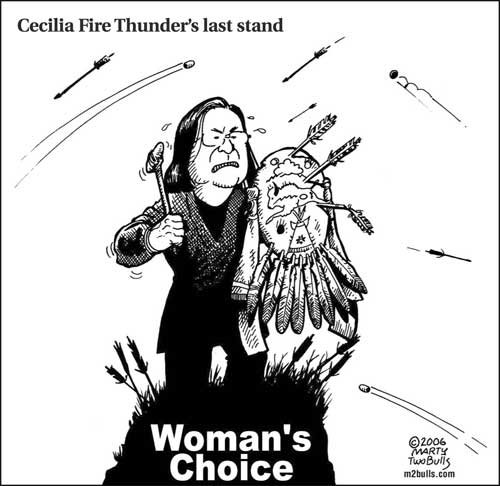
When Netroots Fail: Cecilia Fire Thunder vs. Male Hegemony in Pine Ridge


I thought this was going to be a nice little ray of sunshine piece, about how a modest netroots effort in the face of unjust legislation actually managed to make a difference. A little background for those who missed it the first time: the South Dakota abortion ban pissed off the president of the Oglala Sioux tribe in a major way.
''I'm always an advocate for women, it's all about women. To me, when I heard that [Gov. Mike Rounds] signed the bill including rape and incest, I was going, 'Wait a minute, we know that rape and incest occur - how do we allow white men to tell me what to do with my little brown body?'

''It was just intuitive as a woman to speak up. I shook the tree of denial on the Pine Ridge Reservation and now everyone is talking about it. Did you notice that it's mostly men criticizing what I've been doing?''
Her declaration took the blogosphere by storm and we all did little happy dances.

Her vow to open a women's clinic on the reservation, outside the SD legislature's jurisdiction, almost seemed knee-jerk at the time, a great idea or at least a bold boast that didn't have a chance in hell of becoming reality. But enough people were galvanized by Cecilia Fire Thunder's rhetorical flipoff to the SD governor to send thousands of dollars in donations and letters of support, and enough dollars piled up to make the clinic a reality.

Fire Thunder announced that the Sacred Choices clinic would be built on the reservation in the village of Kyle, to offer comprehensive women's health services--something that's been sorely lacking on the rez.
She said Pine Ridge has a population of beautiful young women who have no education or an awareness of making choices about their bodies.

''This is a good opportunity to do that.'' ''It's a hard enough decision to make, and how many women are strong enough to make that decision and stick by it? So when a woman makes up her mind, she doesn't need someone to undermine her decision. I'm just here to love you and hold your hand and support whatever decision you make,'' she said.
But the movement appears to have come to a crashing halt. The Oglala Sioux Tribal Council yesterday suspended Fire Thunder, pending impeachment, and enacted a ban on all abortions on the reservation.
"It was unauthorized political activity," said Will Peters, a tribal council representative from the Pine Ridge district. "It's just a matter of failing to communicate not only with the governing body but with the people that she was elected to serve."
Peters claims that if Fire Thunder had initially proposed the clinic as a comprehensive women's health center, the tribe wouldn't have had a problem with it. The perception that Sacred Choices was intended solely to provide abortion--despite the fact that Fire Thunder never explicitly used the term "abortion" when talking about the need for a clinic--was apparently too much for the council to take.
"Women need services. Women need support. Right now on the Pine Ridge reservation, there's very little support for women who have been raped," Fire Thunder said.

"If that's the way it was presented to people in the first place, I think she would have been OK," Peters said. "Her stand, by what we read and what we hear from all accounts, was to support abortion. I've never seen such a turn-around."
Peters went on to say that while he feels women should be allowed to control their own bodies, many of the people opposed to the clinic are themselves Lakota women, so he feels that he needs to support them as a Lakota man. I wonder if it bears repeating that Fire Thunder and the women on the Sacred Choices board of directors are also Lakota women who could use some support, that the simple presence of women among the detractors does not trump the greater numbers of female proponents. I fail to understand the logic that dictates a valuable project with the potential to improve the lives of half the reservation's people be discarded because it was initially pitched as an abortion provider.

Kim Tall Bear lauds Fire Thunder as a champion of both female and cultural sovereignity, and articulates the abortion conflict as a Lakota woman herself (emphasis mine):
For those of us who do not subscribe to certain Christian doctrinal teachings, but who do subscribe to cultural imperatives about the sacredness of life, our moral and political response to terminating a pregnancy is not captured by either of the most vocal positions in the American abortion wars: the ''pro-choice'' and ''pro-life'' positions.

My Dakota mother and great-grandmother, for example, did not let me forget the powerful potential of my body to bear children. I was taught that a child is sacred, and that an unwanted pregnancy was to be assiduously avoided through safe-sex practices and, when I was younger, through abstinence.

My mother and great-grandmother never used the words ''choice'' or ''rights,'' but rather they spoke of ''power'' and ''responsibility.'' But my mother and great-grandmother also took a leap of faith that I would have the space to be responsible for my body - that I would not, for example, face rape.

At the same time, I was raised with a politicized understanding of the world. Both women and men in my family and in our tribe endured their share of hardship, including sexual violence. I grew to understand that within a colonial context. Abortion, in that context, might be considered a sad but necessary decision.

We differed from the ''pro-choice'' position in that we spoke of this and all reproductive decisions not as a ''right'' or a ''choice,'' but as a responsibility that grew out of the power in women's bodies. We differed from the ''pro-life'' position in that we recognized that the decision could be shaped by the hardship and violence that haunt Indian people to this day. Our views about the sacred nature of the unborn child were not synonymous with fundamentalist Christian views. From my upbringing, I came to understand abortion as a difficult topic with only context-specific and imperfect solutions.
What happens next for the women of the Pine Ridge Reservation will be largely determined by what happens for the women of greater South Dakota. Betty Bull Bear, one of the board members, said it would be a wellness center, and the board would wait to see what happens with a statewide abortion ban referendum and any subsequent legal challenges before deciding whether to attempt to provide any abortion services.

Meanwhile, they'll start verifying and counting signatures next week from the referendum petition. Volunteers are claiming they already have more than three times the required 16,000-odd signatures, well ahead of the June 19 deadline.

Multiple issues are in play here--cultural views on abortion sometimes twined with and sometimes butting up against women's autonomy and power, entrenched poverty, domestic violence and rape that impacts Native women at a rate four times that of the non-indigenous population, and a mostly male (14 of 17 members) tribal council that has been resistant to the leadership of the first woman Oglala president since her inaguration. This is the second time Fire Thunder has been suspended and threatened with impeachment; she has been viewed as a maverick for going outside traditional channels to secure a loan from a different tribe to finance gaming operations (that impeachment attempt didn't stick). Depending on your perspective, she's either a mouthy woman who has forgotten her place or a courageous leader attempting to fight decades of oppression both within and from outside the Lakota Nation to better her people's lot. The support she enjoys among Lakota women--councilman Peters' claims notwithstanding--suggests the president is not the council member who's out of touch with the people she represents.

Would it have made a real difference if President Fire Thunder had gone through official channels to accept the thousands of dollars in unsolicited donations that poured into Pine Ridge from across the country? Would it have mattered if she had made "comprehensive health care" the first words out of her mouth any time she addressed the issue? As long as some people have a vested interest in keeping abortion or emergency contraception out of any discussion of comprehensive health care, and as long as others have an equally vested interest in maintaining their own gender-based power, I fear the answer will continue to be no.